
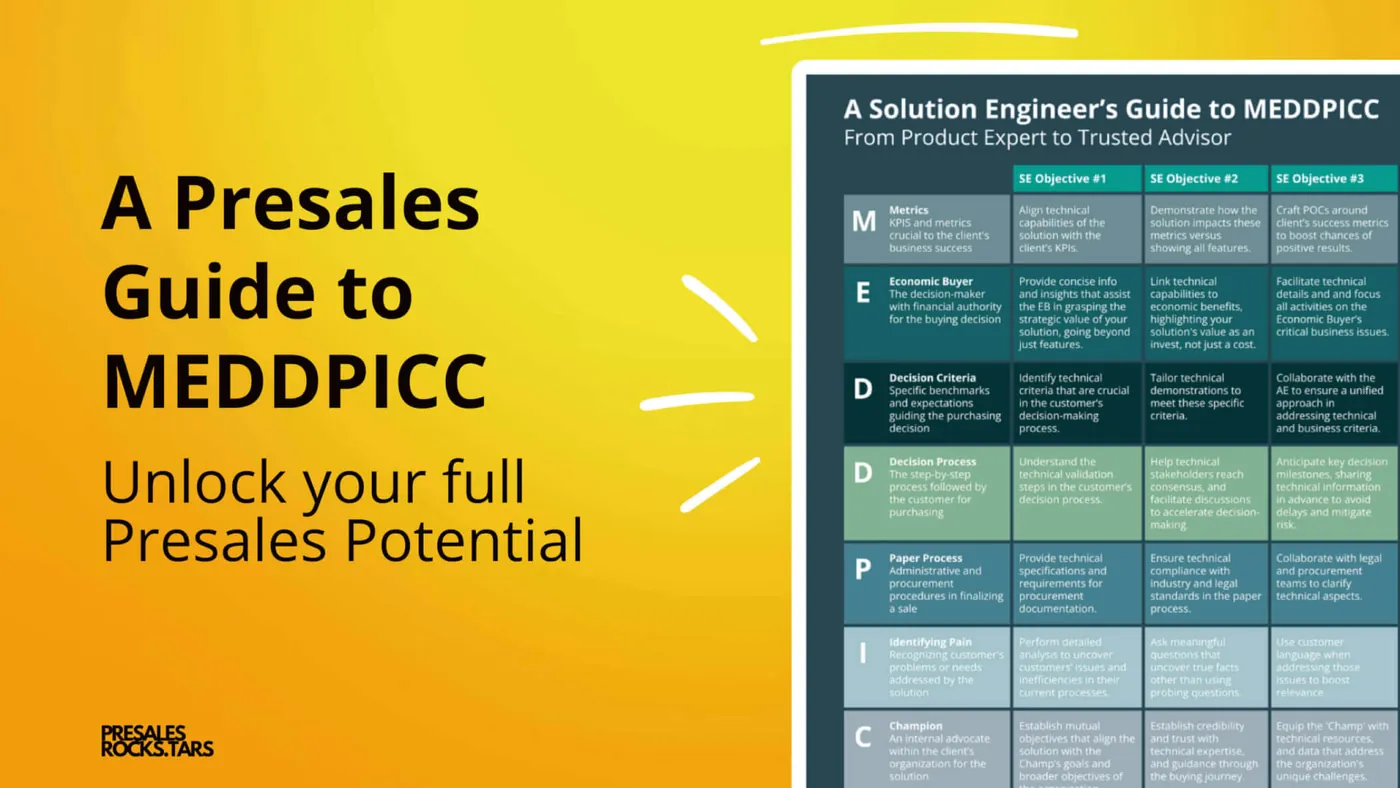
MEDDPICC (or MEDDIC / MEDDPIC) is a popular framework in sales. It helps teams qualify deals by looking at Metrics, the Economic Buyer, Decision Criteria, the Decision Process, Pain, Champions, Compelling Events, and Competition. The goal is simple: avoid surprises and spot risks early.
But MEDDPICC is not only useful for sales. It is a strong tool for Solution Engineers too. SEs combine technical depth with customer insight, which makes them perfect for using MEDDPICC in a more practical and customer-facing way.
Instead of treating MEDDPICC as an internal checklist, SEs can use it to shape better customer conversations. It helps them link product capabilities to real customer goals, explain value in a simple way, and guide buyers through their process. For example, by zooming in on Metrics, an SE can show how the solution moves the needle on what the client cares about most.
Used this way, MEDDPICC helps SEs move from product experts to trusted advisors. It gives structure, clarity, and a shared language for understanding what matters to a customer.
In short, MEDDPICC becomes more than sales qualification. It becomes a practical framework for SEs to build trust, run better meetings, and make their demos and recommendations more relevant.
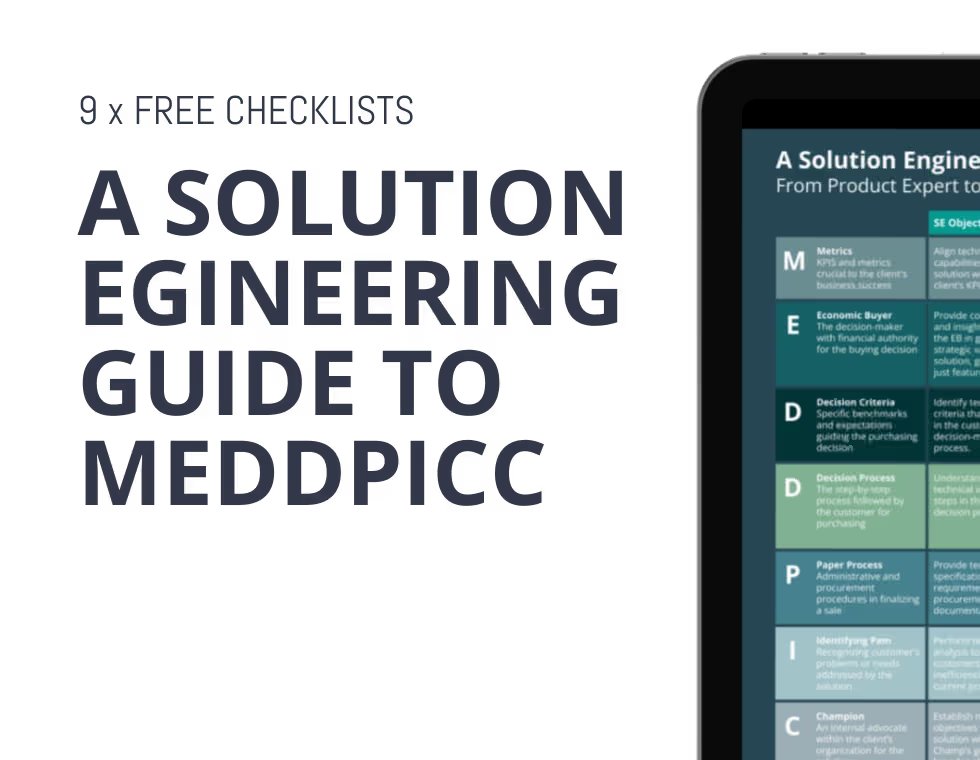
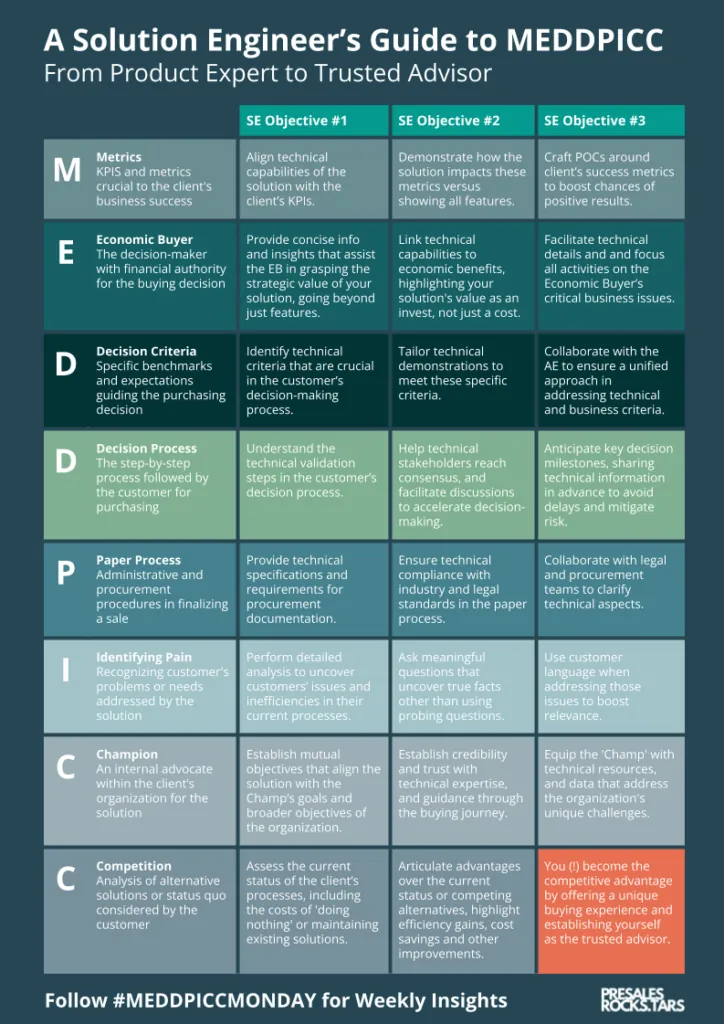
TLDR: How SEs can use MEDDPICC to improve presales performance
MEDDPICC is not only a sales tool. It helps Solution Engineers run better conversations, understand what matters to a customer, and show value faster.
- Align with real needs: SEs can map their solution to the customer’s goals, priorities, and blockers. This moves the discussion from features to real outcomes.
- Stand out in the market: By focusing on each customer’s unique situation, SEs can position their solution in a way that feels tailored and relevant.
- See the full picture: MEDDPICC gives structure. It helps SEs understand the buying process, the decision criteria, the pain points, and the urgency behind the deal.
- Build trust: A clear, customer-focused process makes conversations smoother. It creates trust and improves the overall experience for the buyer.
- Go beyond “the demo”: Used well, MEDDPICC turns SEs into strategic partners, not product explainers. It helps them support the customer long term, not just in one meeting.
MEDDIC vs MEDDPICC: What's the Difference
MEDDIC came first. It's the original six-part framework: Metrics, Economic Buyer, Decision Criteria, Decision Process, Identify Pain, and Champion. It's been the standard qualification method in B2B sales since the 1990s.
MEDDPICC is the same framework with two more letters added: Paper Process (how the deal actually gets signed, procurement, legal, security review) and Competition (who else the customer is considering, including doing nothing). Most sales orgs now run the fuller MEDDPICC version, because deals rarely die on the metrics or the economic buyer. They die in procurement, or to a competitor nobody flagged early enough.
You'll also see "MEDDPIC" (one C) floating around. That's usually just an inconsistent spelling of MEDDPICC, not a separate method.
This guide covers the full eight-part MEDDPICC. If your org still runs on classic MEDDIC, everything here still applies. Just skip Paper Process and Competition.
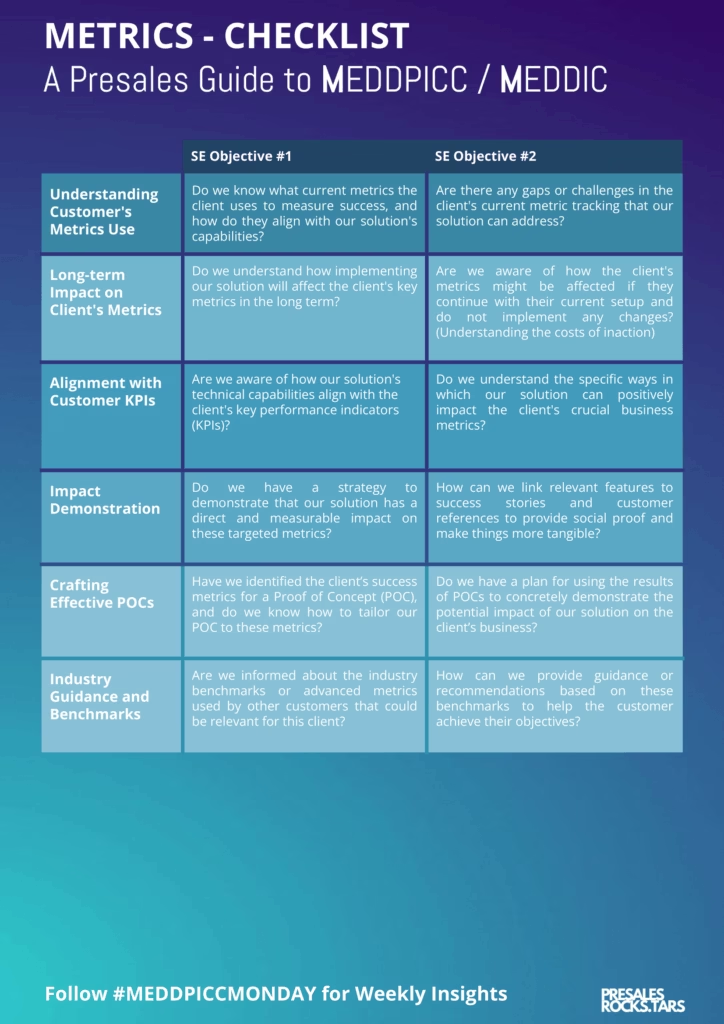
Metrics in the MEDDPICC Method: Customizing Solutions to Fit Customer Objectives
If you look at any good MEDDPICC cheat sheet, Metrics are always the first item, and for Solution Engineers this part is especially important. Metrics represent the numbers the customer cares about and the indicators they use to judge success. When SEs understand these numbers, they can shape their demos and their explanations in a way that speaks directly to what matters most to the customer.
Strong SEs link their solution to the customer’s KPIs by asking simple but meaningful questions. They try to understand what the customer wants to improve, whether it is saving time, reducing cost, increasing output, or making better decisions. Once this is clear, it becomes much easier to show how the solution supports these goals.
This becomes very practical in real situations. If a customer wants better efficiency, the SE can show how relevant workflows become faster. If the customer is planning to scale, the SE can explain how the system grows with the business without creating extra work. If quality is a priority, the SE can demonstrate how the tool reduces errors. In each of these cases, the conversation moves away from features and toward impact, which is where Metrics become powerful.
It is also important to look ahead. Customer priorities shift over time as their market, internal goals, and challenges change. SEs who stay close to their customers can adapt their message accordingly, which keeps the solution relevant and strengthens trust. This also positions the SE as a partner who understands the bigger picture rather than someone who simply shows the product.
In summary, Metrics help SEs connect their solution to real business outcomes. They keep demos focused on what matters to the customer and make the value easy to understand. When SEs use Metrics well within MEDDPICC, their demos become more engaging, their conversations become clearer, and their chances of winning the deal increase noticeably.
Understanding the Economic Buyer in MEDDPICC: How SEs Speak to the Real Decision Maker
In the MEDDPICC cheat sheet, the Economic Buyer is the person who makes the final decision. This is usually someone senior who looks at the business impact of a solution, not the technical details. They care about budgets, company goals, and whether the investment makes sense.
For Solution Engineers, the goal is to show how the solution helps the company reach its goals. This means talking less about how the product works and more about what it changes. If you already captured the customer’s important Metrics, you can use them here. For example, if the customer wants to cut costs or speed up a process, you should explain clearly how your solution supports that.
To do this well, SEs need a basic understanding of the customer’s situation. This includes their industry, current challenges, and what the company is trying to improve. With this context, it is easier to explain why the solution matters and why the timing is important.
Economic Buyers do not need a long technical explanation. They want a simple answer to one question: “How does this help us reach our goals.” If SEs can link the product to the customer’s Metrics in clear language, they make the decision much easier.
In short, when speaking to an Economic Buyer, keep the focus on outcomes, not features. Use the Metrics you already gathered and explain how the solution supports them. This makes the conversation relevant and shows that you understand what the customer is trying to achieve.
Decision Process in MEDDPICC: Making Customer Interaction Smoother
The Decision Process in the MEDDPICC cheat sheet describes how a customer moves from first interest to a final purchase. For Solution Engineers, knowing this process is just as important as knowing the technical needs. It helps you give the right information at the right time.
Every customer has a different way of making decisions. Some need a formal evaluation. Others run internal tests. Some involve many stakeholders. Some move fast, others slow. If SEs understand these steps early, they can plan their conversations and demos to match the customer’s timeline.
At the start of the process, customers often look for a simple overview and clear benefits. Later, when they already understand the basics, they want more detail. This is where SEs can show deeper workflows, integrations, and edge cases. Adjusting the level of detail to the stage makes meetings smoother and avoids overwhelming the customer.
It also helps to think ahead. If you know the customer will worry about integration, security, or change management later in the process, you can prepare examples or materials before these questions come up. This reduces friction and builds trust.
Good SEs guide customers by sharing real examples from similar projects. These stories help customers understand what a successful path looks like and what steps they might need next.
Different companies work in different ways. Some are very structured. Others are informal. SEs who adapt their style to the customer’s culture make it easier for everyone involved to move forward.
In summary, understanding the Decision Process means understanding how your customer makes choices. If you align your meetings, demos, and technical depth with these steps, the whole buying journey becomes easier and more predictable for both sides.