
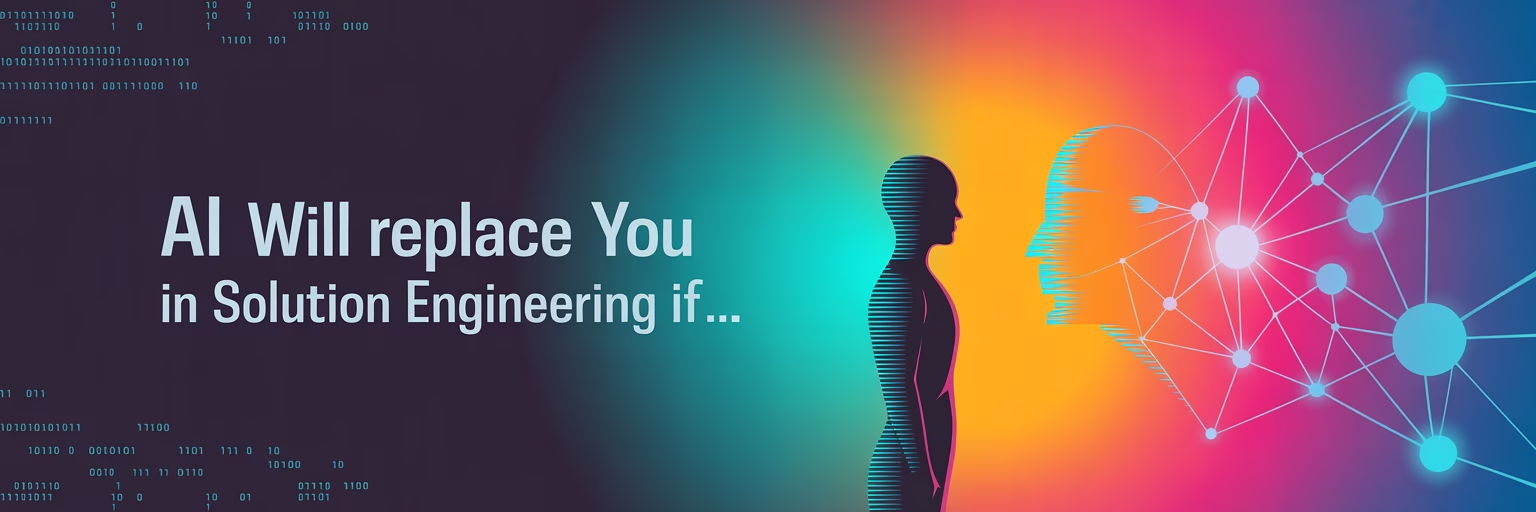
Everyone in presales is talking about AI right now.
Some are excited, some are worried, and many are unsure what it will mean for their role in the future.
The question usually sounds like this: “Will AI replace solution engineers?”
The honest answer is simple. Yes, it can. But only if your job looks a certain way.
If your demo is always the same product tour, AI can do that.
If you wait for your AE or the customer to ask all the questions, AI can do that too.
If your RFP answers come straight from past submissions with a bit of copy and paste, AI already does that today.
If you believe the main value you bring is knowing the product inside out, you will not win against a model that has perfect recall.
If you avoid taking ownership because forecast calls stress you out, nothing stops AI from stepping in.
If you respond to every question by showing “yet another feature,” AI will handle that faster and more consistently.
If you let the AE drive the story while you follow, an AI assistant can follow even more obediently.
If you never challenge the customer’s thinking, AI will not challenge them either, but it also will not complain.
If you talk about features without explaining why they matter, you lower your own value to the point where an automated script could replace you.
And if your demo never connects a problem to real outcomes, a bot will do a more efficient job at walking through the interface.
All of this can be done by AI.
In some cases, it can be done better. And in almost every case, it can be done cheaper.
So should you be worried?
If this list sounds like your day-to-day, then yes, you should pay attention.
But if this is not how you work, then no.
Because real solution engineers do something much harder to automate.
Real SEs guide the customer through their own thinking.
They help buyers understand why a problem matters and why it is worth solving now.
They frame the story behind the product.
They connect the current pain to a better future state and explain what needs to happen to get there.
They ask questions that uncover context, not surface-level symptoms.
They catch small signals in the conversation that shape the rest of the meeting.
They adapt their message to the person in front of them.
They know when to slow down, when to go deeper, and when to stop talking altogether.
They explain the “why” before the “what.”
They create confidence, build trust, and remove uncertainty.
This part of the job is about human judgment.
It is about reading people, not systems.
It is about crafting a narrative that feels credible in the customer’s world.
It is about turning complexity into something simple and actionable.
AI can support parts of this, but it cannot replace the core of it.
Because guiding a customer through a decision is not a technical task. It is a human one.
So yes, AI will replace solution engineers who only run through features, answer questions, and follow a script.
But it will not replace the ones who think, question, challenge, frame, and guide.
If anything, it will make these skills more important.
Because the more AI handles the simple tasks, the more companies will rely on SEs who can drive the real conversations.
In other words, AI will replace the product expert.
But it will not replace the trusted advisor.