
I had to stop watching a demo recording the other day because I got too frustrated with what I was seeing.
It takes a lot for me to pause a recording, but this one pushed me close to the limit.
As part of my workshop preparation, I usually watch ten to twenty hours of demo footage.
I go through them at higher speed to get a broad picture of how teams run their meetings and where the real issues sit.
Most of the time, I see the usual mix of good intentions, rushed preparation, and inconsistent habits.
I also see the same patterns repeat across companies, industries, and team sizes.
So yes, I have seen plenty of “ugly.”
But this one was different.
This one was a masterclass in how to sabotage a demo before it even begins.
And the sad part was that the SE did not stand a chance.
The setup looked completely normal.
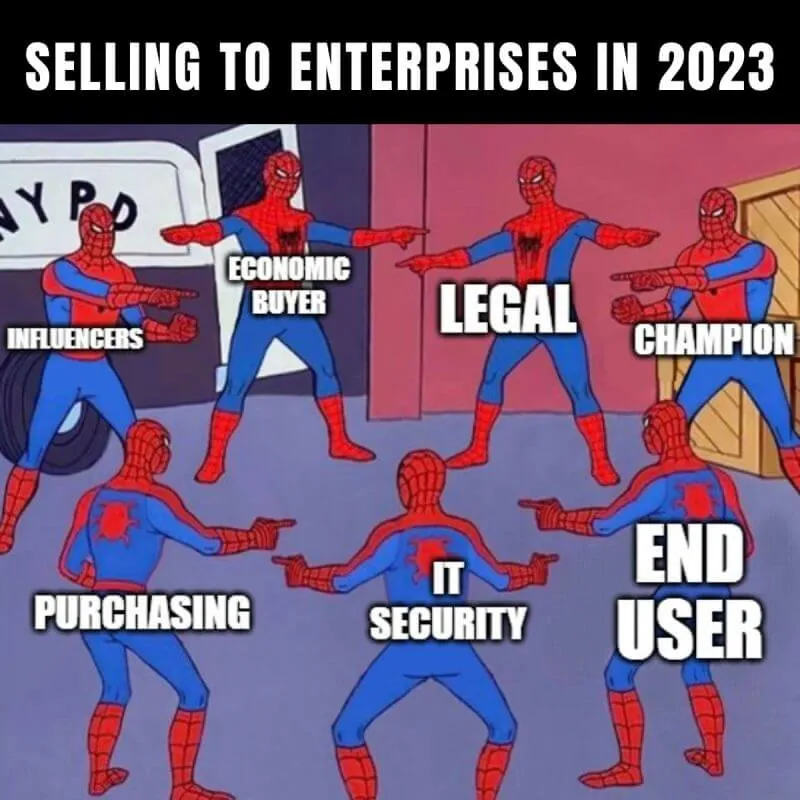
One AE, one SE, and seven people from the customer side ready to hear a convincing story.
The AE opened the meeting with the standard polite greeting.
Then he immediately said: “Thanks for joining. I’ll hand over to my SE, Olli, who’s the product expert. He’ll do a deep dive into our end-to-end platform to give you an idea of what’s possible.”
And that was the entire introduction.
No agenda. No alignment. No purpose. No confirmation of why the meeting existed.
The AE washed his hands of the entire call in under fifteen seconds.
Then disappeared into the background until “next steps.”
This is the moment where my blood pressure started rising.
Because an SE cannot rescue a meeting that has no direction.
Olli actually handled himself well.
He tried to build a structure, asked a few questions, and attempted to create a logical story.
But he was set up for failure long before he shared his screen.
No amount of product expertise can fix a meeting with no objective and no context.
In the workshop that followed, we could not start with storytelling or demo techniques.
We had to go back to the absolute basics.
A demo does not start when you share your screen.
It starts before the meeting even begins.
You need internal and external objectives.
You need alignment between AE and SE on what outcome would qualify as success.
You need a shared understanding of the customer’s situation.
Why they are evaluating a new solution, what is blocking them today, and what they hope to achieve.
You need to recap this context at the start of the meeting so the customer knows you listened.
This also signals that the conversation is about them, not about showing off your product.
And above all, you need to treat your SE as a strategic partner.
Not as a “product expert” you can throw into the spotlight without preparation.
Your SE is there to help the customer understand what the best solution might look like.
That requires more than knowing which button does what.
It requires empathy, curiosity, and the ability to read the room.
It requires guiding the customer through their own thinking, not just through your interface.
So let your SE introduce themselves properly.
Let them explain the experience they bring and why they are the right person to guide the conversation.
Let them be part of the meeting, not a technical assistant waiting for instructions.
Because treating SEs like disposable demo machines helps no one.
If you are an AE and you throw your SE into meetings unprepared, please stop.
Do your homework, prep your agenda, and set the meeting up with intention.
Your SE is your strongest ally.
And in many cases, the only person the customer genuinely wants to talk to.
Respect that.
Protect that.
And use it to run meetings that actually move the deal forward.