
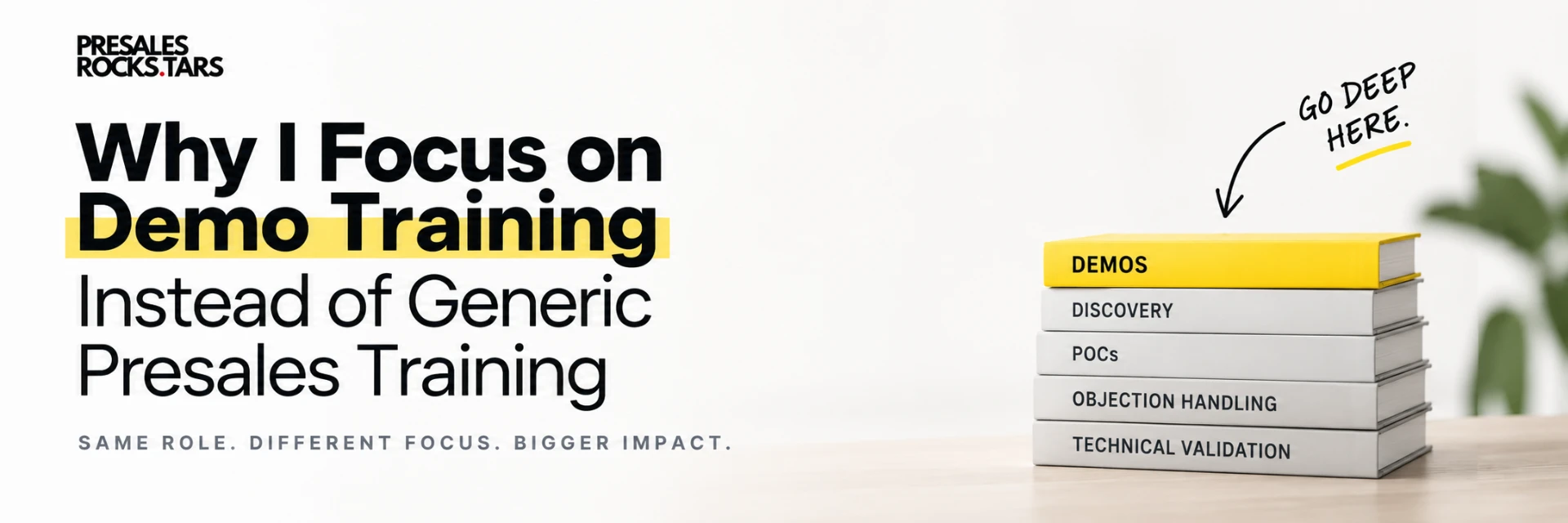
I get asked this quite often: why do I focus so heavily on demo training instead of offering broader presales training?
And the question is fair.
Presales is a broad role. Solution Engineers need to be good at discovery, communication, qualification, technical validation, POCs, objection handling and a lot more.
I agree with all of that.
Good Demo Training Still Depends on Good Discovery
A great demo will not magically fix bad discovery.
If you know very little about your customer, it becomes much harder to run a relevant demo. In many ways, it is still garbage in, garbage out.
Of course, there are demo skills and techniques that can help when discovery was weak. You can still learn how to avoid showing too much, how to ask better questions during the demo and how to keep the conversation focused.
But good discovery makes everything easier.
That is also why I do not treat the demo as an isolated step in the sales process.
In my training, we look at what needs to happen before the demo, what you learned in discovery, which problems matter most, what information is still missing and how you prepare accordingly.
We also look at what happens afterwards and how the demo helps move the deal forward.
Why the Demo Still Deserves Its Own Training
Even though the demo sits inside a much bigger sales process, I still believe it deserves much deeper attention.
For me, it is one of the most important moments in the buying process.
You can do an excellent job understanding your customer. But at some point, your customer wants to see how you are actually going to solve their problem.
They do not really care how clever your discovery questions were. They care whether they can see themselves using your product and whether they believe it will improve their situation.
Can a demo win a deal on its own? Probably not.
Can a bad demo lose one? Absolutely.
You can have the best product in the market and know every feature inside out. That still does not help much if you explain it badly, get lost in technical details, show too much or only get to the important part once your customer has already stopped listening.
Why I Do Not Try to Teach Every Presales Skill
There is another reason why I focus so heavily on demo training.
I do not believe you can go really deep into every presales discipline at the same time.
Discovery, demos, POCs, storytelling, objection handling, communication, technical validation and sales process are all deep topics on their own.
You can cover all of them.
But covering something and being deeply specialized in it are two different things.
The Restaurant Analogy
I sometimes compare this to restaurants.
There are restaurants where you can get pizza, burgers, schnitzel, curry and Chinese food from the same menu.
The food might be perfectly fine.
But usually none of those dishes are so good that you tell everyone they absolutely have to go there.
Then you have restaurants with five dishes on the menu.
They have spent years getting those five dishes right.
That is much closer to how I think about my work.
I would rather focus on one area and understand it in ridiculous detail than offer a little bit of everything.
Demo Training Needs More Depth Than “Talk About Value”
I have been working deeply on software demos for almost a decade now.
Not only on the obvious level of saying things like “talk about value, not features.”
That advice sounds right, but it is still very broad.
The real work starts when you look at the details: what you say, what you leave out, how you structure the demo, how you keep people involved, how you answer technical questions without disappearing into details and how you connect what you show back to what your customer actually cares about.
Those are very specific skills, and they are easy to miss if demo training is only one small module inside a much broader presales program.
Why I Think of Myself Like a Goalkeeper Coach
The football analogy probably fits even better.
I see myself a bit like a goalkeeper coach.
A goalkeeper still needs to understand how the whole team plays. In the same way, a Solution Engineer needs to understand the sales process, discovery, qualification and everything around the demo.
But the goalkeeper also has very specific skills that deserve their own coaching.
Positioning, footwork, decision-making, timing and communication with the defenders are very different from what most other players need to work on.
You only get really good at coaching those things when you spend a lot of time looking at that one position.
That is how I see demo training.
We still look at the bigger picture. But then we go very deep into the part where your customer actually sees how you are going to solve their problem.
The Business Case for Better Demo Skills
And commercially, that part matters a lot.
If your team runs hundreds of demos per year, even a small improvement in demo-to-close conversion can have a major impact on revenue.
If your average deal size is €50,000, improving conversion by only two or three percentage points can quickly add up to hundreds of thousands of euros in additional revenue.
And you do that without buying more leads, increasing your ad budget or hiring more SDRs.
You simply get more out of the opportunities you already paid to create.
So Why Demo Training?
Because presales is broad, but demos are deep enough to deserve their own specialization.
Good demo training should still include discovery, preparation, qualification and follow-up where they directly affect the demo.
But when it comes to the demo itself, I would rather go deep than offer a broad menu of advice that stays on the surface.