
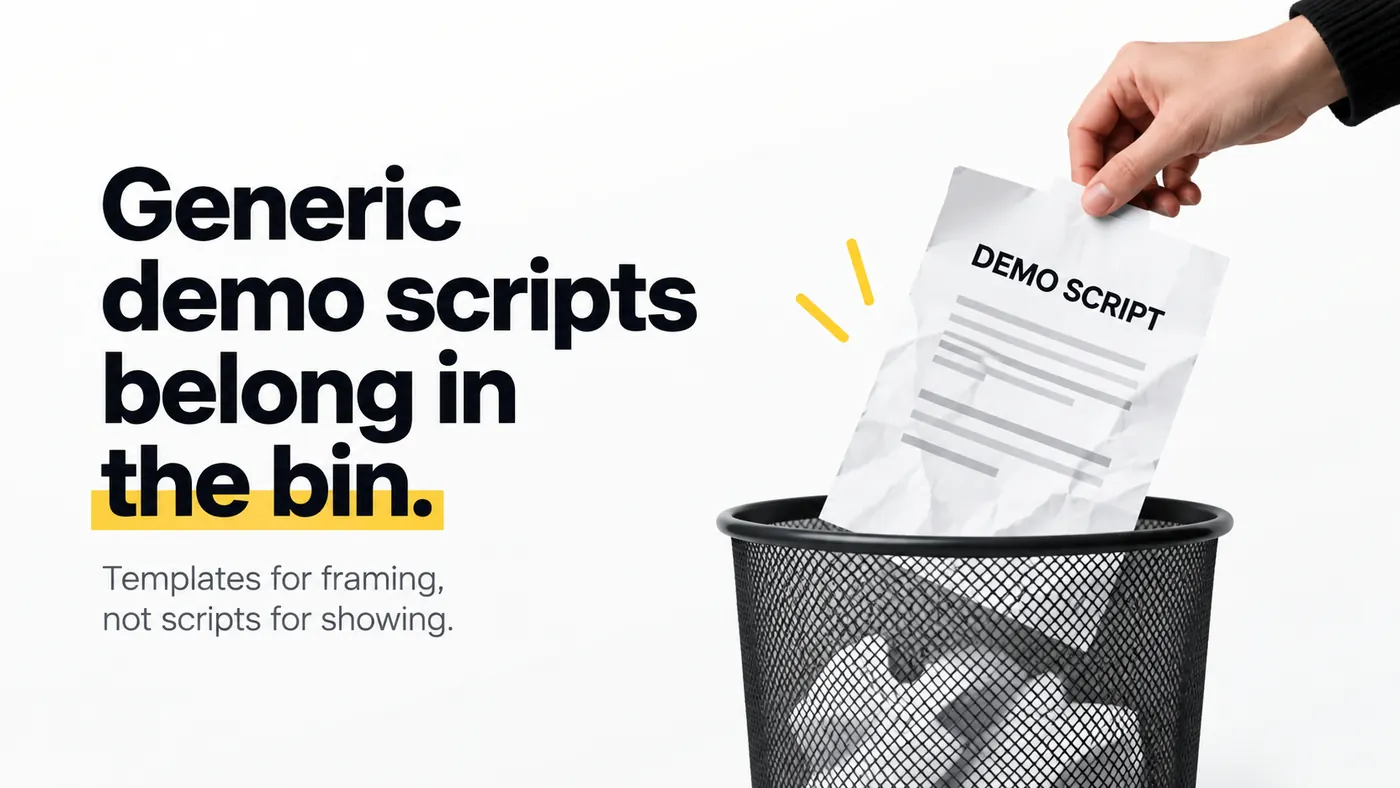
I’m not a big fan of demo scripts.
Whenever I see a detailed demo script, my first concern is that it encourages Solution Engineers to give roughly the same demo to every customer. You follow the same flow, tell the same stories, show the same features and use the same language because that is what the script tells you to do.
And that is pretty much the opposite of what I want a good demo to feel like.
A demo should show your customer how your product helps solve their biggest problems. Ideally, you start with the problem that matters most to them and then work your way down based on their priorities.
Even if many of your customers have similar challenges, they will never describe them in exactly the same way. One customer talks about reducing admin work. Another talks about giving sales reps more time with customers. A third talks about improving data quality.
The underlying product capability might be exactly the same, but the way you position and explain it should change.
That is why I struggle with the idea of a traditional demo script.
The best demo language usually comes from your customer
One of the most effective things you can do in a demo is use the language your customer already uses.
If your customer told you during discovery that their reps are “wasting half of Friday cleaning up CRM data,” I would use exactly that language again during the demo.
“Earlier you mentioned that your reps are currently spending half of Friday cleaning up CRM data. What I want to show you now is how you can remove most of that manual work.”
That sentence is much more powerful than something generic like:
“Our platform provides automated data management capabilities that improve operational efficiency.”
The second sentence might even be technically correct. But your customer now has to translate it back into their own situation.
The first sentence does that work for them.
This is one of the biggest things I look for when I review demos. How often does the SE refer back to something they have actually learned about the customer?
A good demo should constantly remind your customer: This is why I am showing you this. This is how it connects to what you told me. This is what changes for you.
A generic demo script cannot really do that because it was written before you ever spoke to this customer.
Most demo scripts are actually product training scripts
There is another problem I see with many demo scripts.
They are almost entirely about the product.
They tell the SE which screen to open, where to click, which feature to explain and what the feature does. In other words, they are often closer to a product training script than a sales demo script.
You get something like:
“Navigate to the reporting section. Explain the dashboard. Open the filter menu. Show how users can customize the report. Explain the export options.”
That can be useful when you are teaching a new SE how the product works.
But it is not enough to help them run a good customer demo.
The customer does not care that the reporting section has six filters. They care about what those filters help them understand, decide or improve.
The moment your demo script becomes 99% product and 1% customer, you have a problem.
Your demo should follow the customer’s priorities, not your product navigation
I normally want the structure of the demo to come from what we learned before the demo.
What are the customer’s biggest challenges? Which one matters most? What is the impact of that problem today? What does the customer want to improve? Which stakeholders care about it?
That should determine what you show and in which order.
This also means the first thing you show should not automatically be whatever sits on the left side of your navigation menu.
If the customer’s biggest concern lives three menus deep inside your platform, I am perfectly happy starting there.
The demo does not need to follow the architecture of your product. It needs to follow the priorities of your buyer.
That is difficult to achieve with a rigid script.
So should you have no demo script at all?
Not quite.
There are two parts of a demo where I actually think a demo script template can be very useful: the beginning and the end.
The reason is simple. There are a few important things I want an SE to accomplish in almost every demo, regardless of the product or customer.
At the beginning, I want you to frame the meeting properly. At the end, I want you to close the loop and create commercial progress.
The structure can stay relatively consistent. The content inside that structure should still come from the customer.
That is why I prefer templates with placeholders over fully written scripts.
A simple demo script template for your opening
I like a demo opening to establish why we are here, connect the meeting back to the customer’s problem and make it clear what should happen at the end.
A simple version could sound like this:
“Thanks everyone for taking the time today. The goal for the next 60 minutes is to show you how you can [solve the main problem] so you can [achieve the desired outcome].
We’ll leave the last ten minutes for open questions and to discuss whether what you’ve seen meets your expectations. If it does, we already agreed that the next step would be [agreed next step].
Before we jump into the product, I’d like to quickly recap what we’ve learned about your situation so far and make sure we are still aligned. After that, I’ll show you how we would approach the main challenges we discussed.”
The structure can stay the same across many demos.
But [solve the main problem], [desired outcome] and [agreed next step] should obviously change every time.
This gives you consistency without turning the demo itself into a generic performance.
It also avoids one of my least favorite demo openings: spending the first ten minutes talking about your company, your agenda and your platform before anyone has heard why any of this matters to them.
The middle of the demo should not be scripted
Once you get into the actual product, I would move away from a word-for-word script.
You should of course know what you want to show. You should know which workflow best demonstrates the capability. You should have realistic data ready and know which stories or examples might be relevant.
But I would rather prepare customer problems, proof points and transitions than sentences.
For each section of the demo, I want to know what customer problem I am addressing, what I need to show to prove that we can solve it, and what outcome I want the buyer to understand afterwards.
That gives the SE enough structure without forcing them to sound like they are reading from a teleprompter.
It also gives you room to react.
If your customer asks a question, challenges an assumption or suddenly tells you that another problem is much more important than you thought, you should be able to change direction.
A script makes that harder.
Your closing deserves a template too
The end of the demo is another place where I think having a clear structure helps.
Too many demos simply fade out.
The SE finishes the last feature, someone asks whether there are any questions, and then everybody looks at the clock.
I would rather deliberately bring the meeting back to what you agreed at the beginning.
A simple demo closing template could sound like this:
“At the beginning, we agreed that we’d use the last ten minutes to cover any open questions and decide on the next step.
What you’ve seen today is how we can help you [solve the main problem], which should help you [desired business outcome].
Based on what we discussed before the demo, the next step would be [next step].
From your perspective, is there anything you’ve seen today, or anything you still need to understand, that would speak against moving forward with that?”
Again, the structure is repeatable.
The important parts are not.
Your problem, outcome and next step should come directly from the customer conversation.
Use a demo template for structure, not for personalization
That is the distinction I would make.
A good demo script template can help you remember the important parts of the meeting. It can help you frame the demo well, avoid forgetting the commercial next step and give less experienced SEs some confidence.
What it should not do is tell you exactly what to say for the next 45 minutes.
Your customer has already given you most of the language you need.
Use their words. Refer back to their problems. Follow their priorities. Show the parts of your product that help them understand how their situation could improve.
I would much rather see an SE walk into a demo with a clear structure and five good notes from discovery than with a ten-page script.
Because your customer should never feel like they are watching the demo.
They should feel like they are watching their demo.