
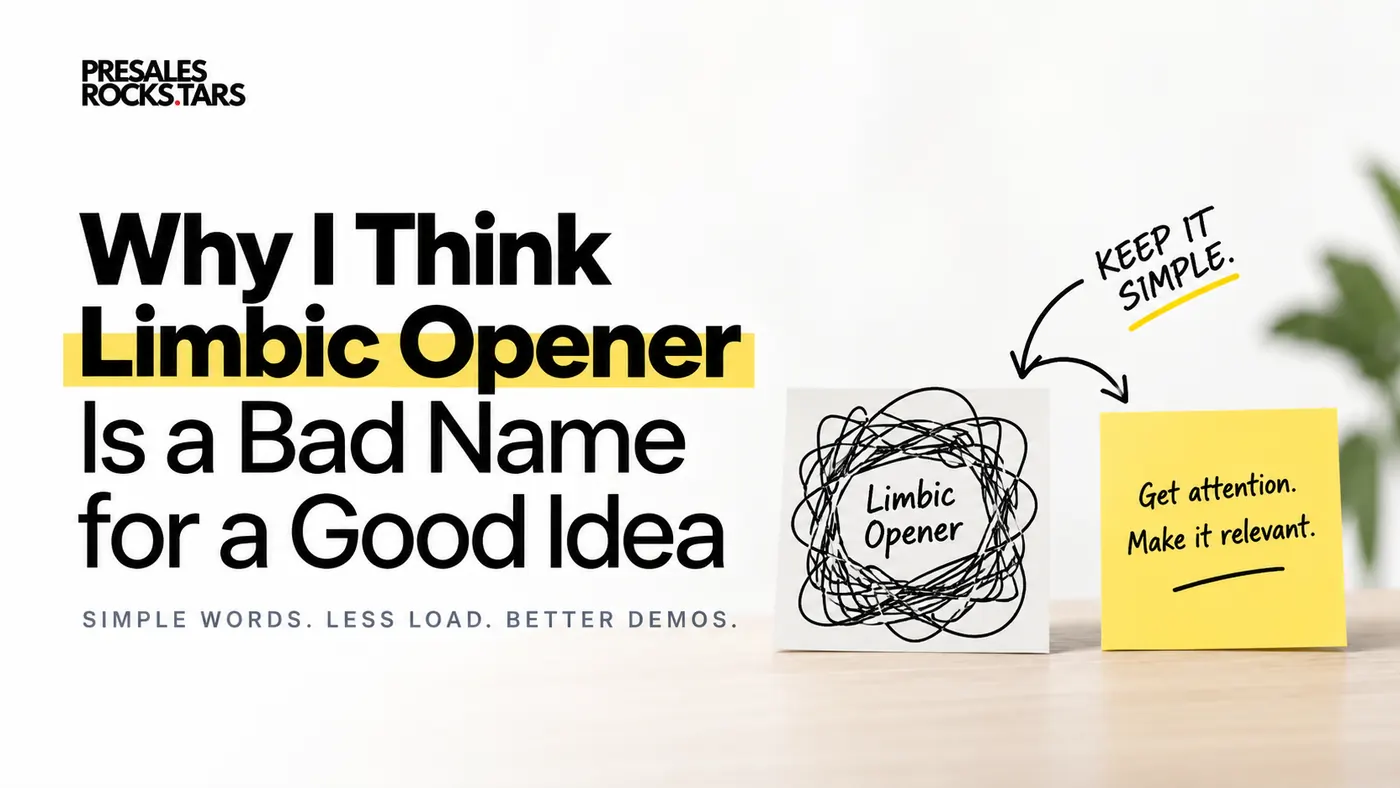
We teach Solution Engineers to make things simple. But then some of us give them terms like “Limbic Opener.”
To me, that is a pretty good example of one of the reasons why so many demos become more complicated than they need to be.
Before anyone gets me wrong, I actually think the idea behind a Limbic Opener is very relevant. The idea is simple: start your demo in a way that immediately gets your buyer’s attention and makes them care.
I fully agree with that. What I struggle with is the name.
If you tell someone to use a “Limbic Opener”, you already assume quite a bit of prior knowledge. You assume that they know what “limbic” means, what the limbic system is, and why this matters in the context of a demo.
Because you cannot really assume that everyone knows this, you usually have to explain the term before you can even explain the actual concept. So you add more complexity just to explain your own framework.
I find that slightly ironic, especially in demo training, because one of the things we constantly tell Solution Engineers is to do the exact opposite. We want them to take something complex and explain it in a way that their buyers can understand immediately.
Good demos should reduce the amount of thinking your buyer has to do
When I review demos, one of the things I pay a lot of attention to is how much mental effort the SE creates for the buyer.
I do not mean that buyers are unable to understand complex topics. Most buyers I work with are perfectly capable of understanding complex software, technical concepts and processes. The problem is that they are trying to understand all of this while a lot of other things are happening at the same time.
They are listening to you speak, looking at your screen and trying to connect what they see to their own environment. At the same time, they may be thinking about implementation, risk, budget, internal politics, another vendor they are evaluating or the meeting they have straight after your demo.
Their working memory is already busy.
That means every unfamiliar term you introduce creates another small piece of work. Your buyer now has to stop for a moment and ask themselves what that term actually means before they can continue following your point.
Sometimes that is unavoidable. If your product is genuinely complex, you will have to explain new ideas. But quite often, we create additional complexity ourselves by using language that sounds more sophisticated than it needs to be.
And that is the part we should try to remove.
Cognitive Load Theory explains this quite well
There is a concept in Cognitive Load Theory called extraneous cognitive load. The basic idea is that some mental effort comes from the topic itself, while some comes from the way we choose to explain it.
If I am trying to understand a genuinely complex technical architecture, some thinking will always be required. I cannot remove all of that complexity without losing important information.
What I can avoid is adding unnecessary complexity on top.
A confusing diagram can create that kind of extra effort. A screen full of fields can create it. Jumping between five parts of the platform without giving your buyer context can create it. Unfamiliar terminology can do exactly the same thing.
If I first have to decode your language before I can understand your idea, you have made the explanation harder than it needed to be.
That is exactly why I find the term “Limbic Opener” so interesting. The underlying concept is not particularly difficult. You want to open your demo with something that is relevant enough to get your buyer’s attention.
But instead of describing that idea directly, you give it a name that itself requires explanation. You have created additional mental work around a concept that was already quite easy to understand.
We do this all the time in software demos
You see the same thing constantly in software demos.
Imagine an SE saying, “This is our dynamic entity resolution layer.”
That might be the technically correct name for what the product does. It might even be the term everybody inside your company uses every day.
But if your buyer does not know what “entity resolution” means, you have just handed them a translation exercise. Before they can understand why the feature matters, they first need to understand what the words mean.
Now compare that with: “This helps you spot when two records that look different are actually the same customer.”
You are explaining the same idea, but the second version gives your buyer something they can understand immediately. They can picture the situation and connect it to a problem they may already know from their own business.
Once they understand the idea, you can still introduce the technical term if it matters. You can say that this is called entity resolution and continue from there.
I am not arguing that technical language is bad. I am arguing that the order matters.
Give your buyer the idea first and the terminology second.
Your buyer should not have to translate your demo
This is one of the simplest principles I use when I coach SEs. Your buyer should not constantly have to translate what you are saying into their own world.
If you say “workflow orchestration”, they should not have to work out which of their actual processes you mean. If you talk about “advanced analytics capabilities”, they should not have to guess which questions those analytics will help them answer. If you introduce a “single pane of glass”, they should not have to figure out what they will actually see there and why it matters to their job.
Every time your buyer has to do that translation themselves, you create extra work.
I would much rather hear something like: “You mentioned that your reps currently spend two hours every Friday cleaning up CRM data. This automates most of that work for them.”
Now I know exactly what I am looking at and why I should care.
The technology behind it can still be incredibly complex. Your explanation does not need to be.
Start with something that already exists in your buyer’s world
One of the easiest ways to make complex things easier to understand is to connect them to something your buyer already knows.
You can use a process they already follow, a problem they have already described, a role they work with every day or a task they already understand. That gives the new information somewhere to land.
This is why I like very concrete language in demos.
Instead of saying, “Our platform improves operational efficiency,” I would rather say, “Today, your team spends about two hours every Friday cleaning up those records manually. This removes most of that work.”
The second sentence gives your buyer an immediate frame of reference. They know the task, the people involved and the pain. They do not have to translate a generic concept like operational efficiency into something meaningful.
Good demos reduce the amount of translation your buyer has to do themselves.
Simple language does not mean making your product sound basic
I think this is where some technical people hesitate. They worry that if they simplify the language too much, they make the product sound less sophisticated.
I do not think that is true.
You can have an incredibly complex product and still explain its value in simple language. In fact, I think being able to explain something complicated in a simple way usually shows that you understand it very well.
Anyone can repeat internal product terminology. The harder part is understanding what that terminology means for your buyer and translating it into language they can actually use.
That is one of the most important skills a Solution Engineer can develop.
Your buyer rarely cares whether you can repeat the internal name of every feature, module or technical component. They care whether they understand what changes for them if they use your product, what becomes easier, which problem goes away and why this is better than what they do today.
If your language helps them answer those questions faster, you are doing your job.
Demo training should follow the same rules
And that brings me back to the Limbic Opener.
Again, I like the core idea. Starting your demo in a way that immediately gets your buyer’s attention and makes them care is good advice.
I just think the term itself does not follow the communication principle behind the advice.
If we tell SEs to reduce cognitive load, avoid unnecessary jargon and use language their buyers understand, our own demo frameworks should do the same.
If I introduce a framework and then spend several minutes explaining the name of the framework, I should probably ask myself whether the name is helping.
I would much rather use a term that people understand the first time they hear it and that already gives them a useful idea of what they are supposed to do.
Every new term we introduce takes up a little bit of attention. Sometimes that effort is worth it because the terminology helps people understand or remember something important. Sometimes we are simply making a basic idea sound more complicated than it is.
That gives me a useful test for demo language in general:
If you have to explain your concept before your buyer can understand the idea, could you explain it more simply?